Contour-following contact motion
An irregular workpiece rotates while the contact assembly follows its visible contour.
What to watch: Track how workpiece rotation and head movement combine around the changing contour.
Open video notesApplication solution
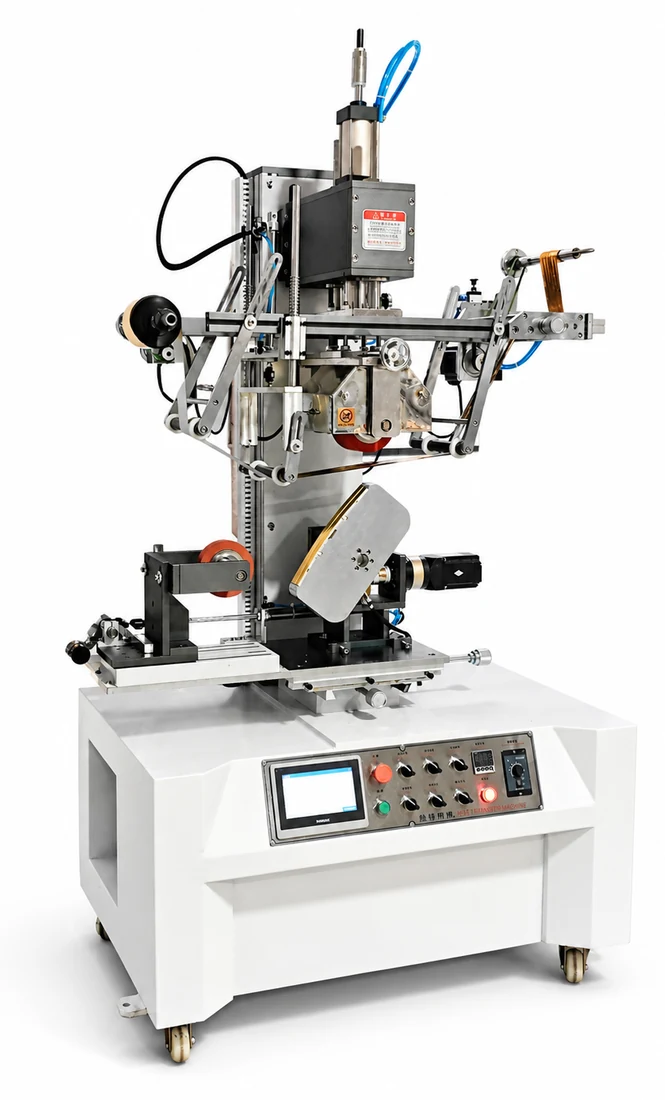
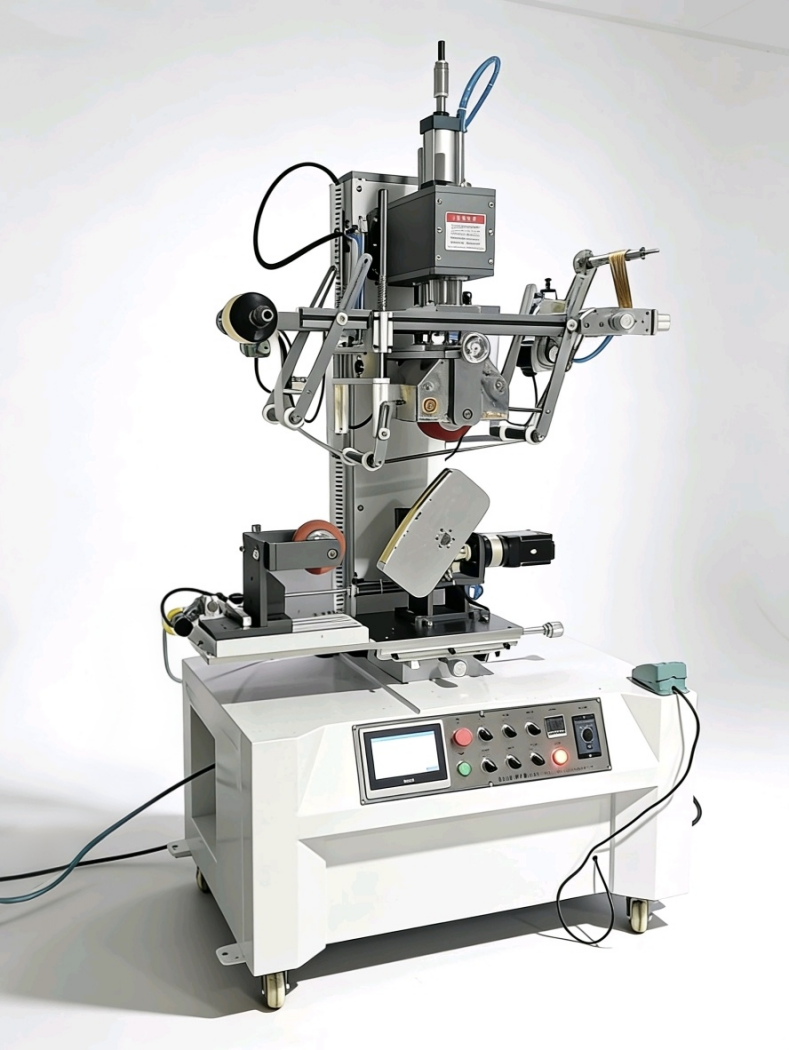
A semi-automatic three-axis route that learns a product profile, stores a recipe and coordinates roller contact along suitable complex surfaces.
Solution overview
Complex surfaces cannot always be stamped with one fixed circular or linear path. The machine first records the surface profile and then reuses the coordinated motion.
Install the product fixture and locate the sample.
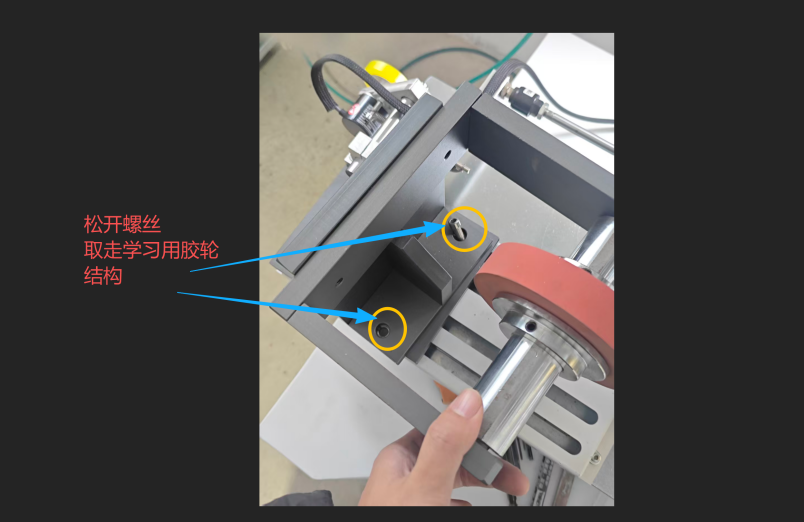
Mount the learning roller structure.
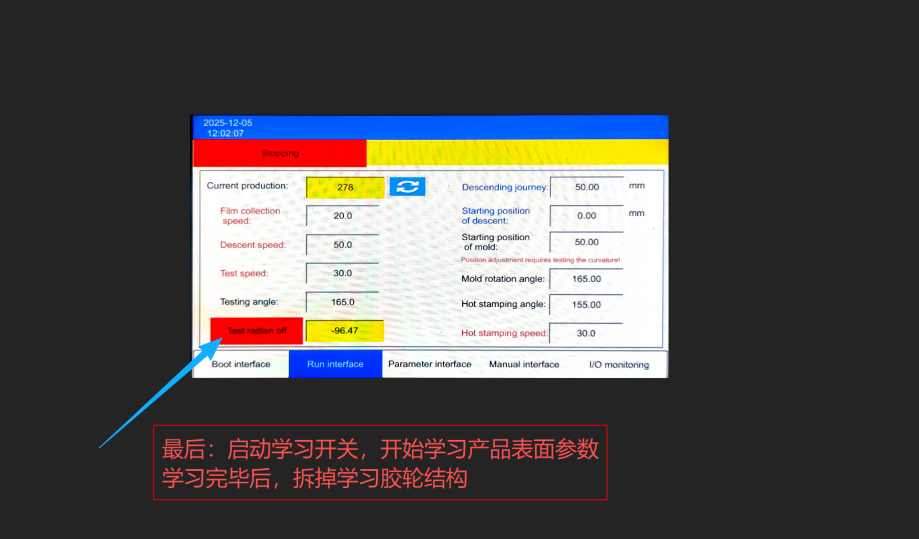
Coordinate the rotation and vertical axes to record the surface profile.
Save the motion profile as a product recipe.
Install the production roller and run the hot stamping cycle.
Machine views
Factory video notes
An irregular workpiece rotates while the contact assembly follows its visible contour.
What to watch: Track how workpiece rotation and head movement combine around the changing contour.
Open video notesA close view of a plain metallic decoration line following a shaped edge.
What to watch: Use the finger only as a pointer and follow the line around the radius change.
Open video notesAn edited view of a fixture moving through a contour-processing station.
What to watch: Observe how fixture indexing and head movement occupy separate parts of the cycle.
Open video notesDecision framework
Profile learning is suitable when a rigid part has a repeatable, accessible contour but a single flat or circular motion cannot maintain the intended contact path. It does not compensate for loose fixturing, changing product posture or an unsupported wall.
Confirm that the decoration path really changes height or direction. Simple flat or cylindrical parts should stay on the simpler route when stable contact can be achieved there.
The fixture, locating surface, part posture, contact tool and recipe identity form one learning reference. A change in any member requires review before reuse.
Run individual motion and repeated dry cycles to check clearance, travel and return state. Dry motion proves mechanics only, not transfer quality.
After relearning, map any remaining defect to the same contour position on repeated samples. Only then use a local correction while other factors stay fixed.
Field diagnosis
| Observed symptom | Priority judgement | Check first | How to confirm |
|---|---|---|---|
| The defect moves after reloading | Part posture or locating repeatability, not a fixed contour correction | Mark the part and fixture datum, reload normally and compare the defect location. | Restore repeatable loading before editing the learned path. |
| A local miss remains at one angle | Repeatable residual geometry, support or contact mismatch | Relearn the complete path and verify the same local miss on repeated parts. | Apply one local correction and check whether only the predicted region changes. |
| The contour path interferes with tooling | The accessible envelope was not established before learning | Stop and inspect the full roller, fixture and product clearance under the machine-specific safe procedure. | Repeat the complete path without heat only after the physical route is corrected. |
| A pause leaves a heat mark | Stationary contact with a hot roller or tool | Remove hot contact before cycle recovery; do not wait in contact while diagnosing. | Verify the safe recovery sequence and inspect the affected part before restart. |
Release criteria
Connected evidence
These routes are connected by selection conditions, process mechanism and validation order; they do not imply universal machine fit.
Related machines
Rounded rectangular boxes and products that need contour-following decoration around curved transitions.
View machine detailsRelated applications
Knowledge base
Commissioning
Selection notes
Questions
It records the coordinated motion needed for the roller to follow the confirmed product surface.
Yes, when the product, fixture, roller and process conditions remain consistent and are checked before production.
The suitable motion range depends on curvature, fixture support and material behaviour.
Contact Hengfa
Send product photos, dimensions, material, artwork position and output target. We will recommend a suitable machine configuration.