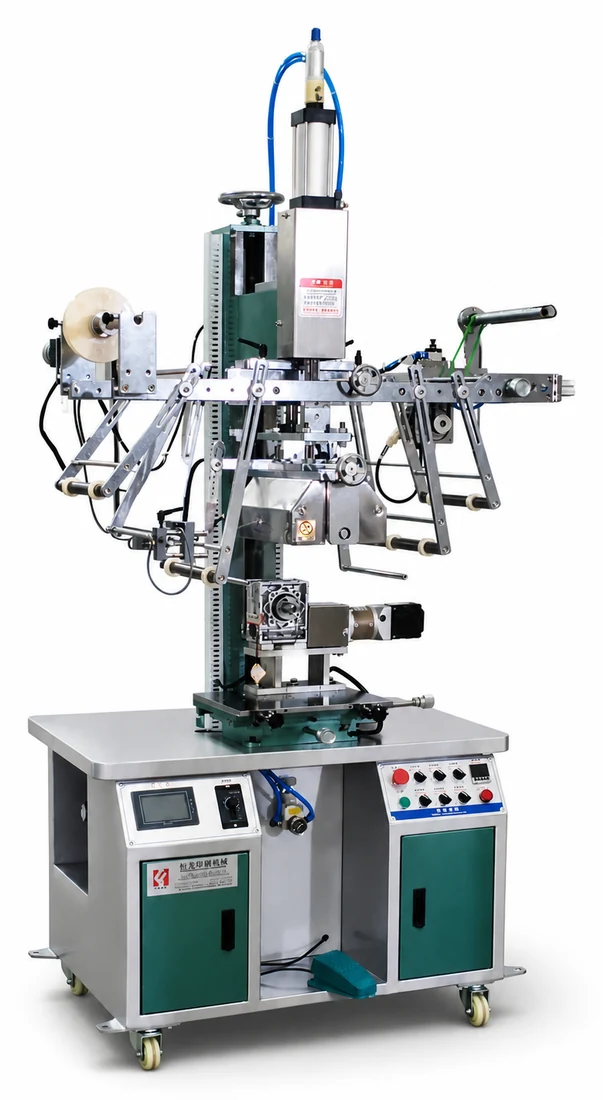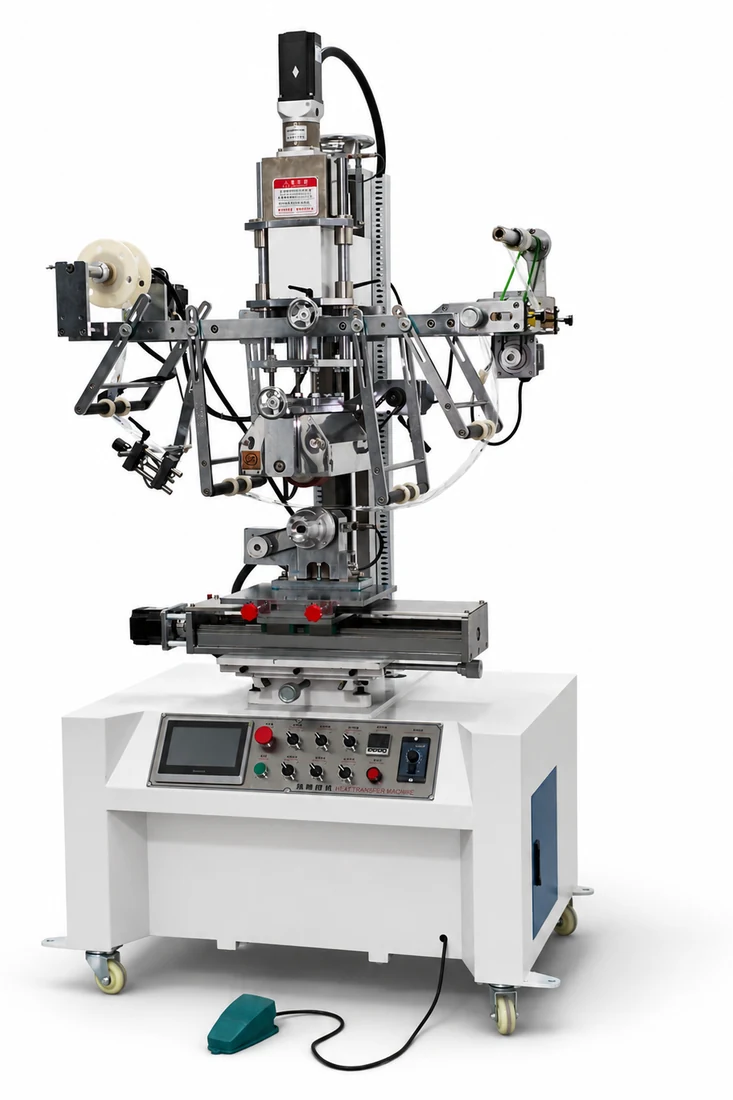
Machine features
Configuration and operation
A three-axis coordinated route for teaching and repeating an accessible roller path around a stable product contour.
Machine overview
HF-200ECR
Rounded rectangular boxes and products that need contour-following decoration around curved transitions.
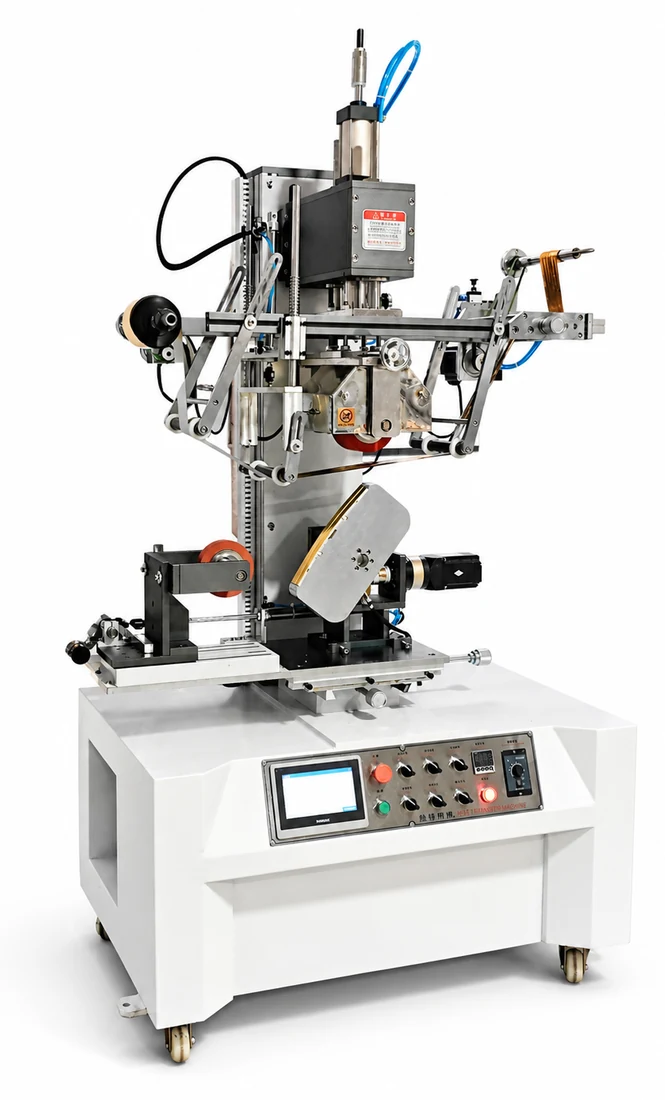
Machine features
A three-axis coordinated route for teaching and repeating an accessible roller path around a stable product contour.
Suitable workpieces
Machine strengths
How the machine works
Secure the sample in its fixture
Teach the accessible profile
Save the motion profile
Run and inspect the decorated part
Decision framework
Use HF-200ECR when a rigid, repeatable contour needs a taught roller path that can be supported and reached without interference. The verified 140 mm pattern width is a size boundary, not proof that every shape inside that width is printable.
Compare several parts at the intended locating surfaces. Variation in moulding, deformation or loading posture must be corrected before teaching a motion path.
Contour learning records a relationship to the current fixture and product posture. A loose or changing datum makes the stored path invalid even when the same recipe is selected.
Check the full roller, fixture and part clearance before hot contact. Sharp transitions, deep recesses and weak unsupported walls may require a different contact route or tooling.
Relearn after restoring the datum. Apply angle-specific correction only when a local defect returns at the same contour position on repeated trials.
Field diagnosis
| Observed symptom | Priority judgement | Check first | How to confirm |
|---|---|---|---|
| The whole path is shifted | Fixture datum, part posture or wrong recipe identity | Verify the physical fixture, locating surfaces and selected product group before editing the taught path. | Restore the datum and relearn with settings otherwise unchanged; the global offset should disappear. |
| One local area remains light | Residual local geometry, support or contact-path mismatch | Confirm the mark repeats at the same contour position after a complete relearn. | Change one local correction only and verify the predicted area on consecutive parts. |
| Contact becomes stationary during a stop | Abnormal recovery left the roller against a heated part or tool | Use the machine-specific safe recovery procedure to remove hot contact before investigating the cycle. | Restart only after clearance, motion state and product condition have been checked. |
| Results vary after recipe recall | The recipe returned but the physical fixture, part or tooling state did not | Compare the current physical setup with the setup used for the approved taught path. | Complete dry validation, warm trials and consecutive-part checks before release. |
Release criteria
Connected evidence
These routes are connected by selection conditions, process mechanism and validation order; they do not imply universal machine fit.
Related machines
Appliance curved plastic parts and products requiring stable rounded-corner transition printing.
View machine detailsFlat and round products that require repeat-position heat transfer.
View machine detailsContact Hengfa
Send product photos, dimensions, material, artwork position and output target. We will recommend a suitable machine configuration.